By ASR David Jamieson, Scripture Reader at Kinloss and Fort George
This is a question I’m often asked by the soldiers I serve. And to be honest, I can’t blame them for being confused.
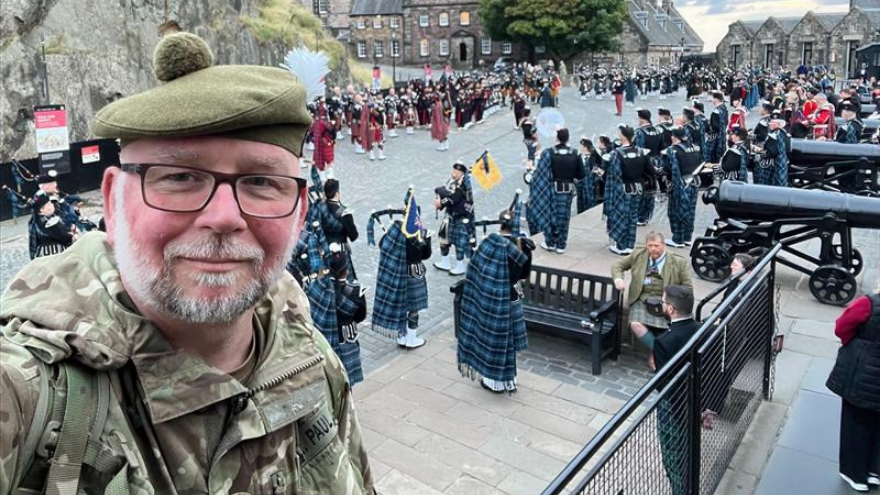
As a Scripture Reader with SASRA, I live and work among British Army personnel, sharing life with them day by day. I wear the same uniform, join them in their workplaces, recreation spaces and the cookhouse. My role is spiritual: to be available, to listen, to offer prayer and to point men and women in uniform toward Christ amid the pressures of service life.
To help us fit naturally into that environment, Scripture Readers are accorded a courtesy rank of Warrant Officer for the purposes of dress and Mess. It means we wear the same style of uniform and rank slide styled as a Warrant Officer, and with the Regimental Sergeant Major’s permission, may dine in the Sergeants’ Mess.
But this doesn’t mean we are Warrant Officers. We don’t hold authority or a place in the chain of command. The rank is a courtesy as we remain civilians. It helps us move comfortably within Army life, to be recognised and accepted as part of the team.
I live and work among British Army personnel, sharing life with them day by day.
Anyone familiar with the British Army knows that rank means everything. It’s the language of respect, discipline and order. A soldier’s first instinct when meeting someone new in uniform is to glance at their rank slide, to see who they’re dealing with and how to address them.
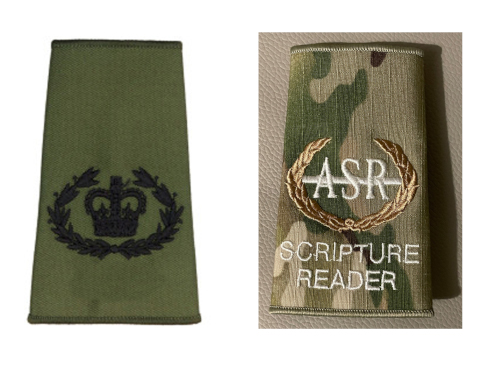
That’s where things get interesting for a Scripture Reader.
Our insignia looks similar to that of a Warrant Officer (see image), but in the centre of the laurel wreath are the letters ASR, Army Scripture Reader, and the words Scripture Reader written below. To a young soldier, it’s easy to mistake one for the other.
So quite often, a soldier will approach, straighten up, and say, ‘Morning, Sir!’ That’s when I smile and reply, ‘Thank you, but please don’t call me Sir.’ Which leads to the inevitable question: ‘How do I address you?’
I explain that my rank slide doesn’t show a military rank at all, but a role. ‘I’m your Scripture Reader,’ I tell them. ‘You don’t call me Sir, call me David, or just SR.’
It is usually followed with another question, ‘What is a Scripture Reader’ and this opens a door that allows me to explain my role.
That little exchange says a lot about the nature of our ministry.
The uniform gives us credibility and access, but it’s the relationships that matter most. Soldiers respect the uniform; it’s part of their world. That respect helps build trust. And once trust is established, they open up. They start to talk about what really matters, family struggles, moral choices, fear, guilt, hope. In those moments, we have the privilege of pointing them to the One who truly brings peace.
‘Come to me, all who labour and are heavy laden, and I will give you rest.’
(Matthew 11:28, ESV)
Even after I’ve explained that they don’t need to call me ‘Sir,’ many still do. Not out of confusion this time, but out of respect, not for me personally, but for the God whom I serve. And that, I find deeply humbling.
The Apostle Paul wrote:
‘We are ambassadors for Christ, God making his appeal through us’
(2 Corinthians 5:20, ESV)
That’s the heart of this ministry. The uniform may open a door, but it’s Christ who changes hearts. That’s what I pray to embody among soldiers, a quiet, steady presence as an ambassador of Christ.
For those who support SASRA, this small piece of military culture helps explain why the work is so effective. Scripture Readers aren’t visitors who drop in occasionally; we live among those we serve. We share their routines, speak their language and walk with them through the highs and lows of service life.
Scripture Readers aren’t visitors who drop in occasionally; we live among those we serve.
The uniform, the rank slide and the discipline all serve one simple purpose: to make the presence of Christ visible and accessible in a world that can often feel closed to faith.
C. S. Lewis wrote:
‘The Church exists for nothing else but to draw men into Christ, to make them little Christs.’
(C. S. Lewis, Mere Christianity, HarperOne, 2001, p. 199.)
That’s the mission, whether in a chapel or a cookhouse, in the barracks or standing in a queue.
Remember the conversations that begin with that simple question.
So, the next time you pray for SASRA, please remember the conversations that begin with that simple question, ‘How do I address you?’ Because behind it lies a wonderful opportunity, to build trust, share the gospel and remind soldiers that ‘the Lord your God is with you wherever you go’ (Joshua 1:9, ESV).